Showing posts with label Culture. Show all posts

Saturday, November 8, 2014

Thoughts on our 39th Anniversary~ The Garden as Teacher ~ Social Media and the New Ghetto


It is a blessing that when the sun goes down, it is easy to see past undone garden chores
It is  a powerful thing, to decide how to see life. You can see the time change this time of year as darkness descending too early or as a chance to enjoy the sunset sooner. 


When we got married, the bets were it wouldn't last.


We were too young to know ourselves. Didn't know each other long enough to know the other. He was an engineer and I was in fashion merchandising.  Our brains operated on different hemispheres.The cynics thought we had nothing in common.

Our own pastor predicted in premarital counseling " You two are going to have problems."  

Dear Pastor, I wish I had asked - Who doesn't? 


No life is without challenges. 


For I am a gardener, I have been a better wife. 

My garden raised me up to rejoice in challenges. It taught me to live like a runner on the track. There are going to be hurdles. Some are simply not going to be liked. Yet each offers not just the chance to plant your forehead where feet should be-  with each leap and land there is the potential to build skill, improve attitude and reap reward.

But only if we are willing to work through. Play through. Pray through every problem.   

A motto for workaholic recovery
Anniversaries  and birthdays. They should be viewed with gratitude. Every one a treasured blessing that may not repeat.   


My reward for foot surgery was yellow Clivia minata from dearest friends

I cannot pass a yellow Clivia  minata without wanting to talk to my mother. English was her adopted language, and she treasured  both flowers and language  like others treasure diamonds. 

My mother was a quiet woman, known to select her words carefully.  She epitomized the wisdom from Colossians 4:6


 "Let your speech always be gracious" 

This age of social media has created new hurdles. At the same time we complain about government intrusion into our private lives, we are cavalier with not just our own lives, but those of family and friends.  

Concurrently, it is fashionable to casually zing those whose different philosophies and beliefs with throw- away insults.  The consequence is that we are self-segregating into thought-ghettos with barbed-word wires. 

Unless this trend reverses, it is my strong belief that the loss of common civility and courtesy is the greatest danger to our future. 

I am of the belief that globally, the weather is largely in God's hands. But our words are our personal responsibility. Like it or not, we are judged by them. 

I wrote friends on this subject last night...

Words have consequences. If I am to eat my words, let their taste be sweet rather than bitter. Unless absolutely necessary. There is a place for bitter, burning hot and even charred flavors from both the kitchen and in words. 

God grant us all wisdom in how we choose our words. 

Until we meet again, Thank you for all YOU do to make the world more beautiful. 


Monday, March 17, 2014

Happy Saint Patrick's Day ~ Braised Corned Beef


 As you slide down the banister of life, 
may the splinters never point in the wrong direction.

~ An Irish Blessing *


Don't blame the Irish for boiled corned beef.

In Celtic Ireland, beef of any sort was a luxury. Cows were kept for milking until the British took over the countryside. The Anglo taste for beef changed up the diet, but not for the poor Irish peasant.

It wasn't until the potato famine forced our ancestors to America, where the salted meat was an inexpensive delicacy, that my family likely ate. Today on the Emerald Isle : that most "Irish" of dishes, corned beef- it is made more often for tourists than the natives. 

34.5 million Americans claim Irish descent in the United States- which is about the number of variations on the boiled one-pot dish which escaped  New England. 

My version turned my husband from a corned beef avoid-er to corned beef lover.  
Bay Laurel Tree grown by Monrovia

There are 3 secrets. The first is to make a bed of celery for the meat to rest on while it cooks. The second is to braise the corned brisket as slowly as your schedule allows. The Holy Grail is for the meat to be lifted to the serving plate when the meat thermometer stuck in its heart reads between 190-210°.   The third is to double glaze with spicy-sweet glaze of apricots and mustard.  Since you can't follow me around the kitchen, here are my notes: 

In a large heavy covered roasting pan, one with a tight sealing lid, make a bed of celery and onion for the meat to lie above the bottom of the pan. Sprinkle the spice package over the top, throwing in an extra bay leaf or so from the garden. Slide the pan, lid on, into a slow oven.

When enough heat releases the aroma of  'eau de  Saint Patrick's Day' perfumes the kitchen -  surround the island of meat with red potatoes, quartered sweet onions and chunks of carrots. Put the lid on the meat and go away. Read some Irish poetry. Divine a poem. 

About an hour before serving, lift the lid, dumping wedges of cabbage on the very top of the vegetables.

Paint the top of the meat with a generous slurry of equal parts apricot jam and Dijon mustard- reserving half the mixture for the end.  Raise the oven temp to  a moderate 350°F and plop that lid down one last time. 
 Sur la Table carries first class   Staub roasters.


In about half an hour, the cabbage leaves will have wilted, signalling time to check on how deeply a fork stabs the other vegetables.  They can stay longer with the beef or come out with the cabbage. 

The meat needs to go in one more time to get rid of any palor.  Spread the rest of the sweet slurry on top. Turn the oven up to 400° for just 15 minutes longer- keeping an alert nose for anything headed towards becoming a burnt offering. 

What you want is a roast at that magic temperature mentioned back towards the beginning of this post. 190° F is when the connective tissues soften. Much past 210, and you are headed  from gourmet into the land of cardboard.


Tender, salty meat. Sweet Glaze. Creamy potatoes. Colorful vegetables. Corned beef done well is a ritual worth repeating more than just on Saint Patrick's Day

Until we meet again, Thank YOU for all YOU do to make the world more beautiful.

* Selected from Irish Blessings are posted at About.com/ food and wine.

Saturday, March 1, 2014

Part 3 ~ GWA Santa Barbara Tour ~ Alice Keck Park Memorial Gardens.


"Time Keeps on  slipping, slipping, slipping, into the future." 
~Steve Miller, lyrics from  "Fly like an Eagle"  


In 2012, the 1 million-plus readers of Birds and Blooms voted the 1976 rock anthem by Steve Miller the best song about birds. Ever.  

Okay. So the bird my lens followed was a seagull instead of an eagle. It was still on a mission. The same as we. To get fed before moving on. Overhead, the clouds pregnant with life-giving rain were about ready to sweetly drench the earth~ but if we didn't hurry, also soak the gourmet sandwiches and salads. 


At Billy Goodnick's suggestion, we gathered at the stone wall at the top of the Erythrina mound, overlooking the pond.   


We had 2 more stops: soon there would be raindrops dancing on our heads.  Nan Sterman and helpers quickly laid out the casual gourmet spread  from nearby Panino. 

It was rather humbling to realize that two guests flew from the farthest side of this continent to join us. Former American Horticulture Society President Arabella Dane and her husband, Nat- what a treat to our tour garnered that level of interest.   


Billy poured the history of this place into our minds. 

Filling a full city block, it once served as the grand estate of Albert Herter's mother. Surrounded by gardens, her mansion was a repository of artwork of his, including lamps designed for Tiffany, artwork by his wife Adele McGinnis, and furniture designed by Herter Brothers, a major New York design firm, also a family enterprise.  

After the  matriarch died, Albert Herter evolved into a hotelier, remodeling the home, adding bungalows and reopening the property as the El Mirasol Hotel. Until it was damaged by  twin fires in the mid- 1960's, the hotel was a long-favored spot to vacation at by those who expected the finest accommodations. 


It's heyday as a hotel past,  there were attempts to revolutionize the property's character with high-rise development. However, the local citizens prevailed in creating property's highest and best use not in commercial usage- but as a place of where plants are largely the guardians of public  peace and serenity . 

During her lifetime, Alice Keck Park, daughter of oilman and philanthropist W.M Keck, never took credit for providing the funds to purchase the property for public preservation. Not until after her death was the benefactor's name disclosed.  

How Alice's name was incorporated in honorarium took some consideration. Alice Keck Park Park - how words sound together is important.


Alice Keck Park Memorial Gardens. Time slipped away from the days where on this spot stood a fine family home. Slipped past the days as a hotel. Slipped to where the influence of this place is even greater now, when trees  surpass architecture in prominence. 

Such is life. Dreams change. What you didn't even imagine possible when you began your journey through time may not be your greatest accomplishment. 

Until we meet again, Thank YOU for all YOU do to make the world more beautiful. 


Wednesday, February 19, 2014

Part 2- GWA Santa Barbara Tour~2 Rancho La Huerta~ The Old Mission Santa Barbara Garden


"It is not easy to convey a sense of wonder, let alone resurrection wonder, to another. It's the very nature of wonder to catch us off guard, to circumvent expectations and assumptions. Wonder can't be packaged, and it can't be worked up. It requires some sense of being there and some sense of engagement."

~ Eugene H. Peterson 

To experience a historic garden, to learn how people engaged land and life in the context of time longer than what a generation walks, a garden is more compelling  than a walled up study hall.

The beauty of Santa Barbara is far more complex than what we learned from our 4th grade text books when when we arrive at the chapter on California missions. Santa Barbara is the central belly button of in the string of missions run up the coast. Its location was set by need, its scenic beauty shaped by disaster as well as by man. 

DSC_0857
Photo from SantaBarbara.com 
In 1769, the Spanish Crown authorized 21 missions to be built from San Diego northward. Each was a day's ride by donkey. The missions were not only an exercise in spreading Catholicism: the national interest included the political motive to forestall Russian colonization of coveted territory. 

Huerta (pronounced Where-tah) is Spanish for a kitchen garden.  Even in hostile territory, man cannot live by bullets alone. Every settlement required a fertile space, with access to water and reasonable protection from marauders be dedicated to food crops.   Seeds from the new and old worlds were tended with prayerful reverence. 

While the actual Mission Era was bracketed within 65 years- its effects are the foundation of modern California commerce and culture.
             
Distinguished educator Jerry Sortomme channels reams of knowledge to GWA group
Fast forward a couple centuries

As dawn was breaking on June 29, 1925, a 6.8 earthquake violently shook beneath the Santa Barbara Channel. The nearby earthen Sheffield dam; the ground beneath it liquefied. The dam collapsed; a knee-high wave of water shoved cattle and all which lay in its path to the sea. Downtown Santa Barbara's buildings trembled until most of what remained was rubble. The mission was slightly spared, its facade significantly damaged, the collection of statues- destroyed.  

Three men were singled out as civic heroes for turning off the city gas and electricity on that day, preventing full-scale destruction and carnage. The civic fathers and citizens used the opportunity to re-brand the city's architecture from mostly Moorish to Spanish Colonial.  


The land near the mission was not a priority.  For some decades, where The Huerta now flourishes, it would have fairly been described as a dumping ground. However, you can't keep a good garden down. As a family's culture is expressed in the meals we serve, California's civic history is most authentically expressed in horticulture.  

When the time was ripe,rubble was reclaimed from the neighborhood, re-purposed into walks and walls. The terrain tamed into usable terraces. In 2003, the La Huerta Historic Gardens project officially kicked off.  Jerry Sortomme,  Professor Emeritus of Environmental Horticulture at Santa Barbara City College was named La Huerta Manager.


Bananas and Citrus 
Citrus were grow from seed
Artichoke allowed to set seed shows its thistle ethnicity

Not all produce was consumed.  A portion must be saved to parent future crops. 

 Dr. Ein Sheimer in Israel

 Apples are not a crop associated with low-chill California coastal communities, but the Anna Apple, developed by Dr. Ein Sheimer in Israel, thrives at La Huerta.


The use of spare Spanish roof tiles to mark plant names is a practical take-away  from the garden.

Not just for plants which are showing,


But for dormant plants. Or to hold a spot in the garden. Here, the common name of seasonal aster marks the spot of what will follow is written in English


On the tile reverse, the Latin designation is neatly printed.

*Note -  When turning tiles over, be careful of what might be hiding underneath. Spiders like dark spaces.

Image of Erigon 'Sea Breeze' by San Marcos Growers


( l-r) Betsy Green compares notes with Nan Sterman  
We were honored to have Betsy J Green, a well-regarded local  history and garden writer who volunteers at La Huerta. She joined Jerry to assure the dozen and a half gardener communicators that our bushels of questions would be addressed as quick as we could think of them- or e-mail later. 


Archaeological sites are treated far differently than back when I was a child. In the 1960's, it was no big deal to take souvenir gleanings. At that time,  a construction worker at Santa Barbara City College took part of this assemblage home. It moved with him to another state. And back. Realizing, a couple decades later, that the fashioned rock was best kept in public hands, he returned the item to the professor. 


The rock was stored at the Environmental Horticulture Department for years. 
OMSB Director Tina Foss determined the rock was  Chumash era- or earlier- it
was approved for viewing at Old Mission Santa Barbara. It became part of a history-scape presentation. Which is like old school dioramas- only way cooler. These displays are life-sized, contain authentic material and you can walk right up.

Likely, the rock was used to grind acorns and native grains- corn came to this part of the world after a pestle ground the rock's concave indentation. What was the stump used for is not known, but certainly sparks conjecture. The state of our sense of wonder was now reborn. 


When the Professor asked the premier begonia expert of the time, Rudy Ziezenhenne if any American indigenous begonias were used in Alta California missions, he was presented with the species 'Blood of Christ' or in Spanish 'Sangre de Cristo'.

The common name denotes the resemblance of unopened red flowers to drops of blood. The symbolism of stems gathered in church vases needs not explanation. 

Until we meet again, Thank YOU for all YOU do to make the world more beautiful.


La Huerta is located in a restricted zone. Tours are limited and by advance registration only. Please link to the contact page.


Saturday, July 27, 2013

Rose Society of Saddle Back Valley ~ California Tuscan Entertaining Home and Garden


There are many styles of design. What elevates the good and proper to the great and memorable is courage and authenticity.


James is unafraid to experiment, mixing roses with succulents to great effect. 

In his youth, this homeowner mowed lawns for spending money. 

Life was good.  Coming home to his native California after time living in Virginia, he and his partner found this home in the enclave of  Nellie Gail, an equestrian friendly luxury subdivision of Laguna Hills.

Approximately 250 of 350 roses were planted this year 

The home and garden was a bit more ordinary in appearance when the publicity-shy  couple took possession  of the 4,296 square foot home 7 years ago. Then, it was sheaved in proper elements of anonymous origin.

The homeowner recalls the front landscape  at the time they moved in was not much more than  " a big rolling lawn with a stucco planter around the base of the coral tree." Near the garage was " a  no man's land of volunteer palm trees and weeds."


Lawns are used for soft footing to wander through planing beds on.
The well-traveled couple understood that while the home was beautiful, it did not achieve its full potential.  It needed character, a sense of place, an aura of generosity.

With this mission in mind, for each of the past 7 years, the couple sculpted and adorned their home and garden, one area at a time.   James explains the wisdom of  choosing one area at a time to upgrade as "by focusing, we got the detail right." Not only that, the majority of the property remained usable at all times.


Living in an area blessed with the rare climate of Mediterranean Tuscany, many of the design elements and plantings reflect the uncommon commonality of good weather.


From one approach the home is first seen where the horse trail crosses
The garden is about balance. An English garden would be out of place without the strong California influence  created by use of succulents and cactus as well as the more traditional outposts of foxglove and daylily.

Stacked stones visually added textural interest while pushing out the framing of usable planting areas from the lawn.


Iron lighting grounds the froth of roses from visually floating away. 
The garden is both beautiful and serves the practical purpose of providing a cutting garden for entertaining at home and away. As James delightedly reports, he suspects their frequent dinner invitations are due to the lavish hostess bouquets picked the same day as they are presented.


Before we go inside, take a look at the creative mix of foliage and flower potted up at the entrance.


Most of the home was closed to prying eyes, but from what we were allowed to traverse, behind the beauty you sense how the rooms were planned with the intent to entertain larger groups of people who might be enjoying a live performance of the caliber of someone such as David Burnham,  the man nailed the role of Fiyero in Wicked.

The inside renovation began at the front hall. The staircase was originally white wooden spindles. James arranged for cutting back and rounding off the base of the design for aesthetic appeal- and more room for people to move about with ease at the bottom landing.


Plain plaster pillars were cut, fitted with molding and painted in a replication reminiscent of fine European woodworking found in manor houses.


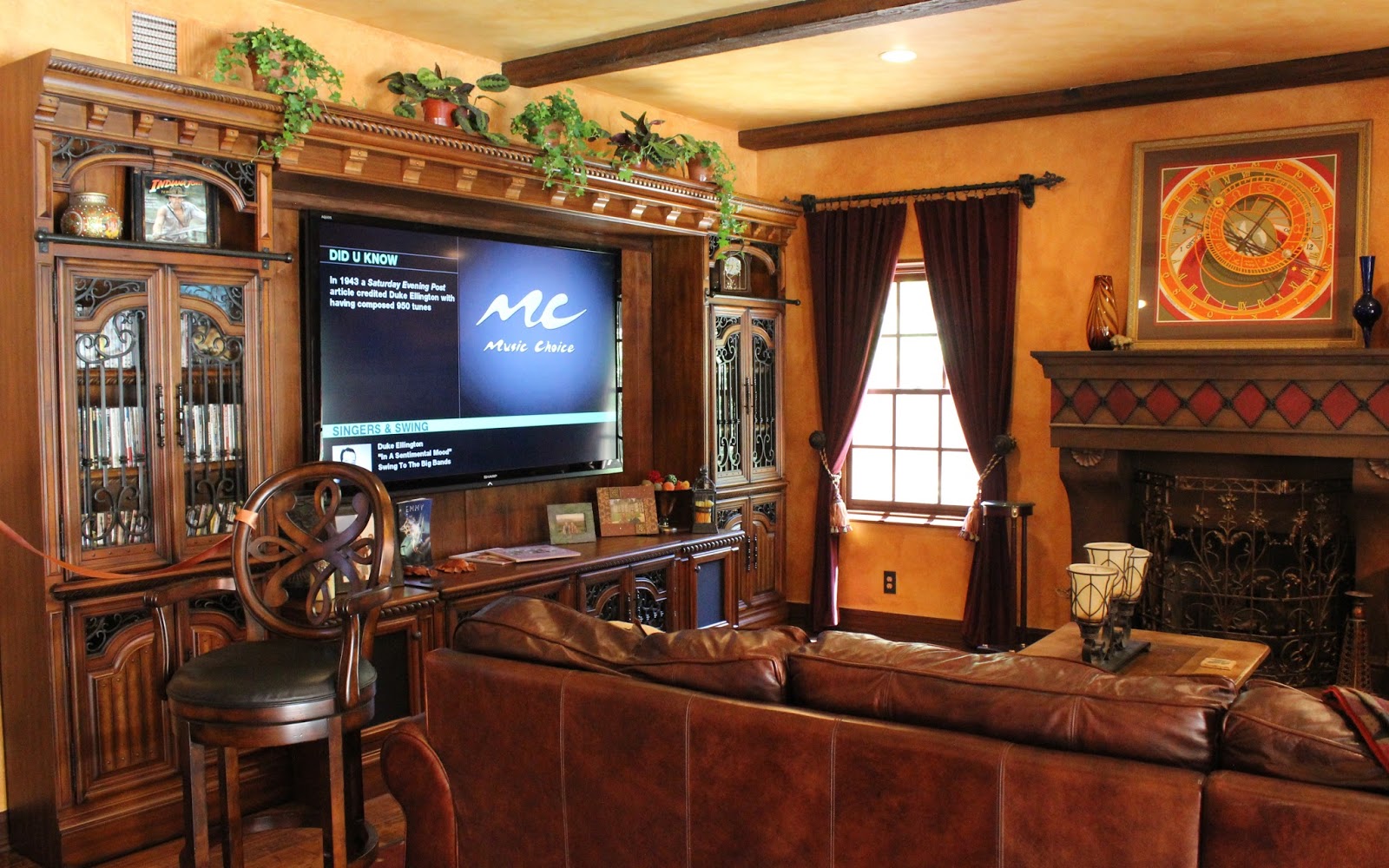
The old gold of the chandelier adds a restrained pop of elegance against the deep wood tones of a formal library.
This library benefited from the luxurious appointments observed on a trip to India just 2 years ago.


Michele Dawn Designs  brilliantly executed depth of color on the interior walls. The magic glow conjured from wines, copper  and metallic gold rubbed into each each other....  magnificent! Equally stunning were the lighter tones of Venetian plaster- a technique requiring patience beyond the  typical house painter. 

Let's walk through a bit of the home without any words. Let my humble images let the house tell its story....


Ah, in the backyard were wonderful reminders that fine design is not about being high end. Fine design is about comfort and beauty appropriate to the owners and the setting.

Little vignettes I found absolutely charming included this hall tree  in the shelter of  the patio . 

James says "I needed something tall and narrow to cover up an old intercom system that we have yet to remove.  I found the damaged hall tree at a second hand shop for about $20 and used some leftover fabric from redoing the headboard on the bed in the master suite. I tacked it to the back and used some of the gardening tools." Voila!


Close up detail


Different proportions of related warm colors highlight the architectural interest. Tall urns are available at Lowe's. 
For those of us old enough to remember the decade of brown, tan and sand- how dreary that color scheme dated so quickly. Here's the design note to explain  what saves this arrangement from the same decorate- by- numbers dullness. The traditional tones of gold, brown and terracotta are saved from cliche' by the  jade rim on the slender ceramic urns. Repeated further back in the picture, it little touch of diversion from a strict colorway adds charm.


James  says of the enchanting cabana on the far side of the pool, that  when they moved in, it was an avoided eye-sore of weathered wood and worn-out fabric overlooking a dusty horse trail.

Fresh paint, clean fabric and dense plantings- voila'- a destination perfect for an intimate chat between friends.  


This lovely outdoor room...


 on a chilly night- the double armed heaters allow more guests to linger before heading home.


Thank you dear readers, for joining me on this tour of  a home loved to its full-potential. 

Until we meet again, Thank you for all YOU do to make the world more beautiful!


Michelle Dawn 949. 350.3340